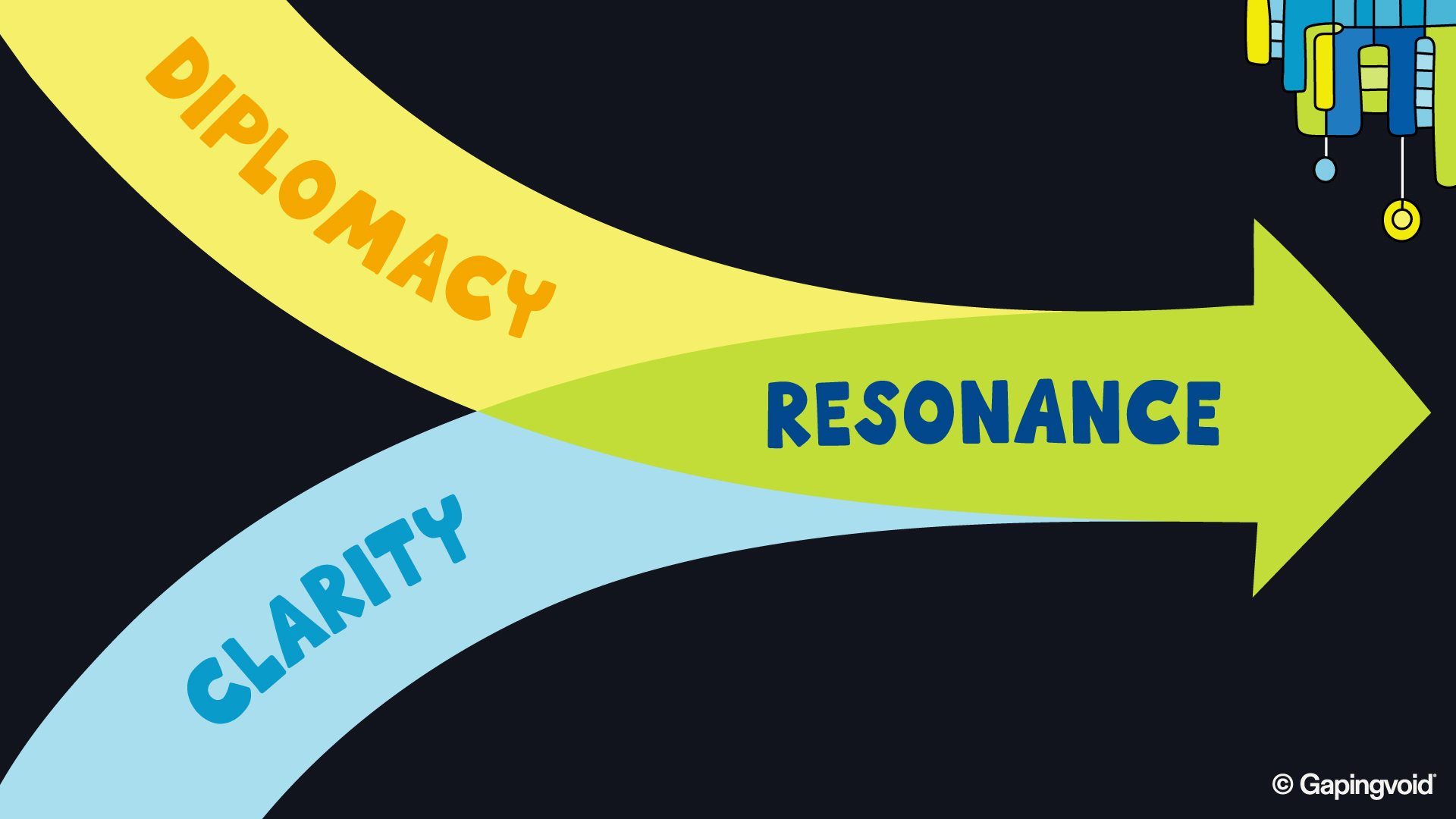
Diplomacy plus clarity equals resonance.
That's not a compromise. It's a synthesis.
The leader who is only direct risks landing the message in a way that closes people down. The leader who is only diplomatic risks never quite landing it at all.
Resonance is what happens when people actually hear what you're saying — and something shifts as a result.
The paradox is that both directness and diplomacy can produce resonance or destroy it, depending on the context.
Know when to be directandKnow when to be diplomatic
When directness serves your culture
Clarity is a form of respect. When a leader says exactly what they mean — without softening, hedging, or wrapping it in so much context that the message disappears — people know where they stand.
If your cultural aspiration includes honesty, accountability, or a team that gives and receives real feedback — directness is likely above the line.
A team that has agreed to call things as they are, or that trust means telling the truth, needs a leader who models that.
Directness is what makes those agreements real.
When directness constrains your culture
Directness becomes a constraint when it lands as bluntness — when the message arrives but so does something else. When clarity tips into criticism. When honesty stops feeling safe.
If your cultural aspiration includes psychological safety, candour, or a team where people speak up — directness delivered without care can quietly close the very conversations you're trying to open.
People hear the message. But they remember how it felt.

When diplomacy serves your culture
Questions create clarity.
Sometimes the most direct path to the truth isn't a statement — it's a question that helps the other person see it for themselves.
"What outcome were you aiming for there?"
"How do you think that landed?"
"What would you do differently?"
That's not avoidance. That's diplomacy in service of clarity. And when it works, the insight is owned by the person who needs it — not delivered by the person who already has it.
If your cultural aspiration includes growth, learning, or a team that reflects and improves — diplomatic delivery is often what makes feedback land rather than bounce.
When diplomacy constrains your culture
Diplomacy becomes a constraint when it becomes avoidance.
When the message gets softened until it disappears. When the conversation happens around the issue but never quite reaches it. When people leave feeling like something was said — but they're not sure what.
If your cultural aspiration includes clarity, trust, or genuine accountability — a team that mistakes diplomacy for honesty will struggle to build any of them.
The kindest thing is often the clearest thing. Diplomacy that never arrives at clarity isn't kind — it's just comfortable.
The question for your team
When you think about the culture you're trying to build —
Where does directness serve your people — and where does it close down the conversations you need?
Where does diplomatic delivery create the conditions for real honesty — and where does it become a way of avoiding it?
What does resonance look like in your team? And how do you get there?
Culture Science Cards gives your team a structured way to surface those questions — and land somewhere honest together.
Above the line. Below the line. In your context. For your culture.
Images in this post developed by © Gapingvoid Culture Design Group, and used with great thanks by Culture Science Cards.