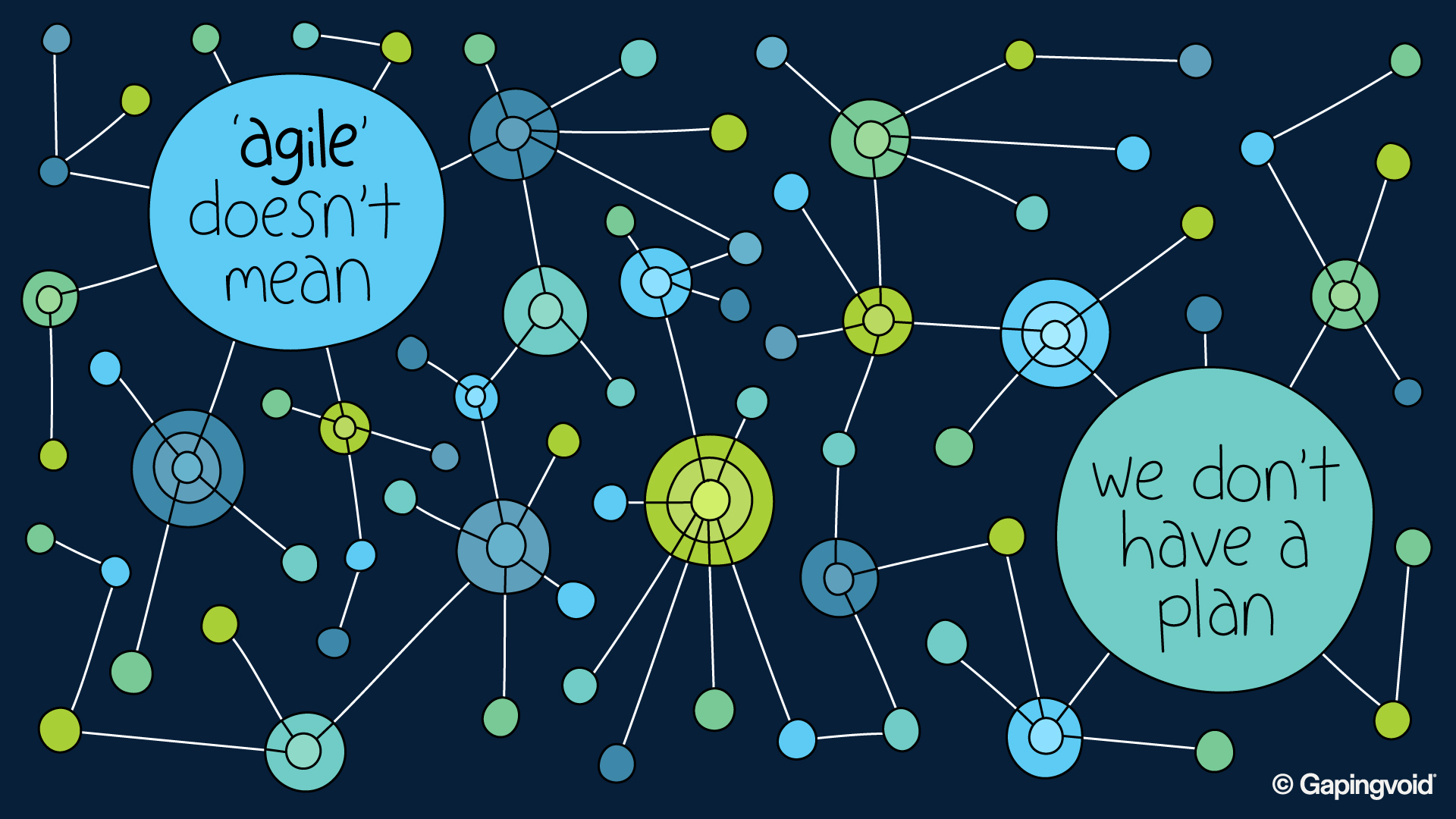
Agile doesn't mean we don't have a plan.
It means we don't worship it.
That's a distinction worth sitting with — because most teams fall into one of two traps.
The first: a plan so fixed that no amount of new information can shift it. Changing it feels like failure, so it doesn't get changed — even when it should.
The second: so much flexibility that there's no real plan at all. Every week is a reset. Every obstacle is a reason to pivot. Direction exists in theory but not in practice.
The paradox is that good flexibility requires good planning. You can only let go of a plan well if you had a real one to begin with.
Know when to planandKnow when to adapt
When planning serves your culture
A good plan creates shared direction. When a team knows where it's going, why it matters, and what it will take to get there — people can make decisions independently without losing alignment.
If your cultural aspiration includes clarity, ownership, or a team that moves without being told — a well-understood plan is what makes that possible.
Planning isn't about predicting the future. It's about building enough shared understanding that when the future surprises you, the team can respond together.
When planning constrains your culture
Planning becomes a constraint when the plan becomes more important than the outcome it was designed to produce.
When teams keep executing a plan that isn't working because changing it would mean admitting it was wrong. When process takes priority over progress. When the plan protects itself.
If your cultural aspiration includes adaptability, learning, or continuous improvement — a culture that over-values its plans will struggle to do any of them.
When flexibility serves your culture
Flexibility allows a team to respond to reality rather than resist it. When new information emerges, when conditions change, or when a better way becomes visible — the ability to adapt quickly is a genuine competitive advantage.
If your cultural aspiration includes innovation, responsiveness, or a team that learns fast — flexibility is often what separates high performers from those who are always playing catch-up.
The goal isn't to follow the plan. It's to achieve the outcome. Flexibility keeps that distinction alive.
When flexibility constrains your culture
Flexibility becomes a constraint when it becomes instability.
When direction shifts so often that people stop committing to anything. When every plan feels temporary. When effort gets invested in things that will change before they're finished.
If your cultural aspiration includes reliability, trust, or a team that delivers on its commitments — too much flexibility is corrosive.
Flexibility without planning is just reaction. Planning without flexibility is just rigidity.
The culture you want lives somewhere between the two — and only your team can decide where that line sits.
The question for your team
When you think about the culture you're trying to build —
Where does planning create the shared direction your team needs — and where does it become a cage?
Where does flexibility make you stronger — and where does it create the kind of uncertainty that costs you?
What needs to be fixed — and what should remain open?
Culture Science Cards gives your team the language to make those distinctions explicit — so they're agreed, not assumed.
Above the line. Below the line. In your context. For your culture.
Images in this post developed by © Gapingvoid Culture Design Group, and used with great thanks by Culture Science Cards.