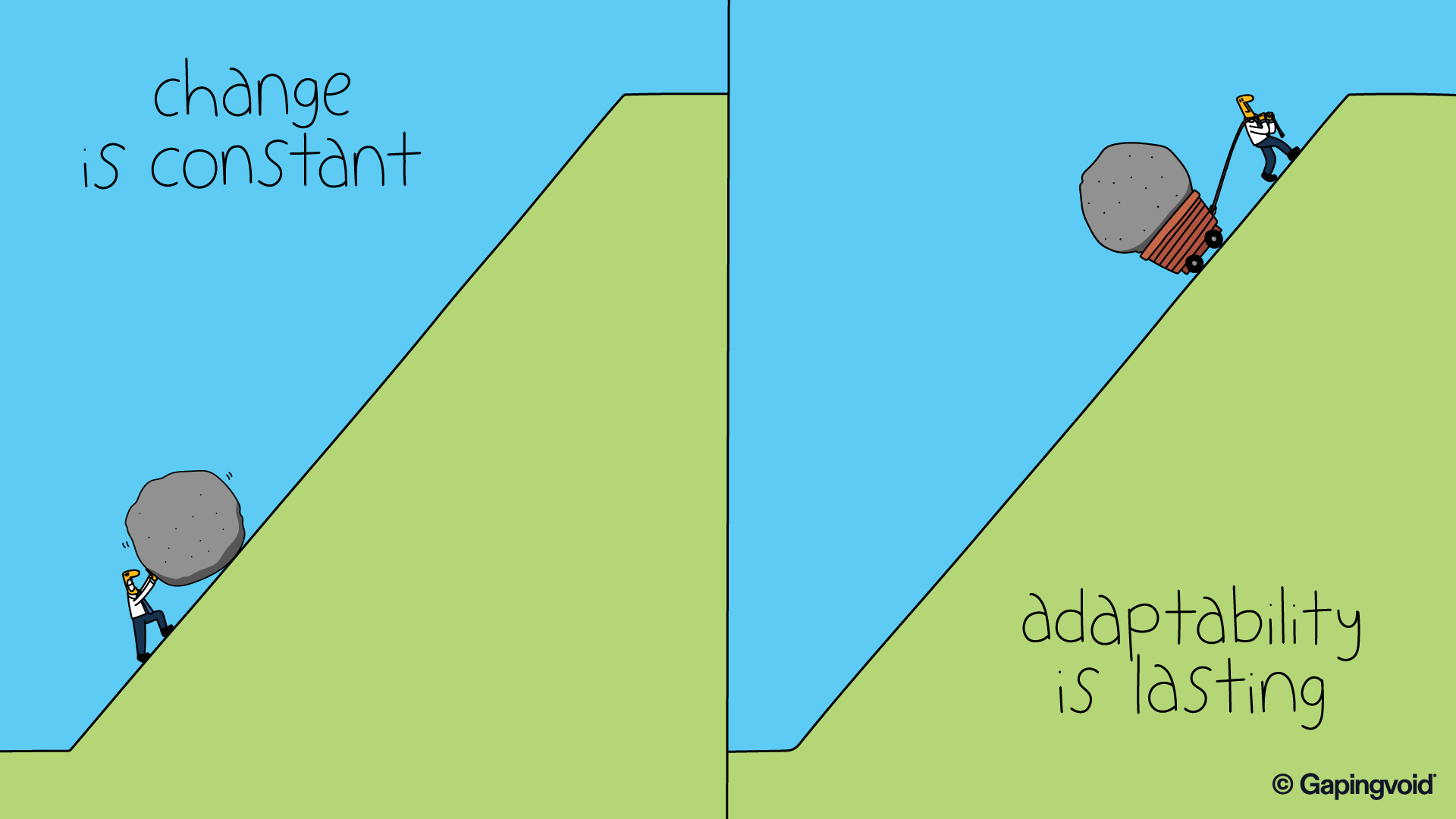
Change is constant.
Adaptability is lasting.
Those two ideas belong together — and they're at the heart of the final paradox in this series.
Because the question for leaders isn't whether to change. Change is happening regardless.
The question is what to hold constant while everything else shifts.
The leaders who navigate this well aren't the ones who resist change or the ones who chase it. They're the ones who are clear about what's fixed — their intent, their values, their standards — and flexible about everything else.
Know when to be consistentandKnow when to adapt to the situation
When consistency serves your culture
Consistency builds trust. When people can predict how their leader will show up — what they'll stand for, what they'll prioritise, how they'll respond — they feel safe.
If your cultural aspiration includes trust, clarity, or psychological safety — consistency is often what creates the foundation for all of it.
A team that has agreed on how they work, what they value, and what they expect from each other needs a leader who reinforces those agreements through consistent behaviour — day after day, not just in the big moments.
Consistency is what turns values from a poster into a practice.
When consistency constrains your culture
Consistency becomes a constraint when it becomes rigidity.
When the same approach gets applied regardless of what the situation needs. When a leader is consistent in their behaviour but not in their purpose — holding to a pattern rather than to an outcome.
If your cultural aspiration includes adaptability, growth, or learning — a culture that values consistency above all else will struggle to change even when it needs to.
The world changes. Teams that can't adjust with it don't survive it.
When adaptability serves your culture
Adaptability is what allows a team to stay relevant.
When a leader responds to new information, adjusts their approach to the person and the context, and models the willingness to change — they build a team that can do the same.
If your cultural aspiration includes resilience, innovation, or a team that grows through challenge — adaptability is likely above the line.
Change is constant. The teams that treat adaptability as a capability rather than a disruption are the ones that find opportunity in it.
When adaptability constrains your culture
Adaptability becomes a constraint when it becomes inconsistency.
When direction shifts so often that people can't find their footing. When the leader adapts to every pressure and every voice — and people stop knowing what actually matters.
If your cultural aspiration includes stability, trust, or clear direction — a leader who is always adjusting can create the kind of uncertainty that makes it hard to commit to anything.
Consistency is being reliable in your intent. Adaptability is being flexible in your response.
Both matter. The culture you want requires both.
The question for your team
When you think about the culture you're trying to build —
What needs to stay fixed — no matter what changes around it?
What should be allowed to flex — and how much?
Where is your team currently more consistent than it needs to be? And where is it more adaptive than it can sustain?
And that's the series
Eleven paradoxes. No right answers.
Just better questions — put on the table, together, by people who care about the culture they're building.
That's what Culture Science Cards was built for. Not to tell your team what good looks like. To help your team decide — in your context, for your people, toward the culture you actually want.
Because the research is clear on this.
Agreed behaviour sticks. Assumed behaviour drifts.
Every paradox in this series is a decision point. And every decision point is an opportunity to be intentional — to ask which side of the tension serves your culture right now, and to agree on that together.
You won't always get it right.
I know I don't.
But every time you notice which side you defaulted to — and whether it served the culture you're trying to build — you increase your chances next time.
That's the work.
Images in this post developed by © Gapingvoid Culture Design Group, and used with great thanks by Culture Science Cards.