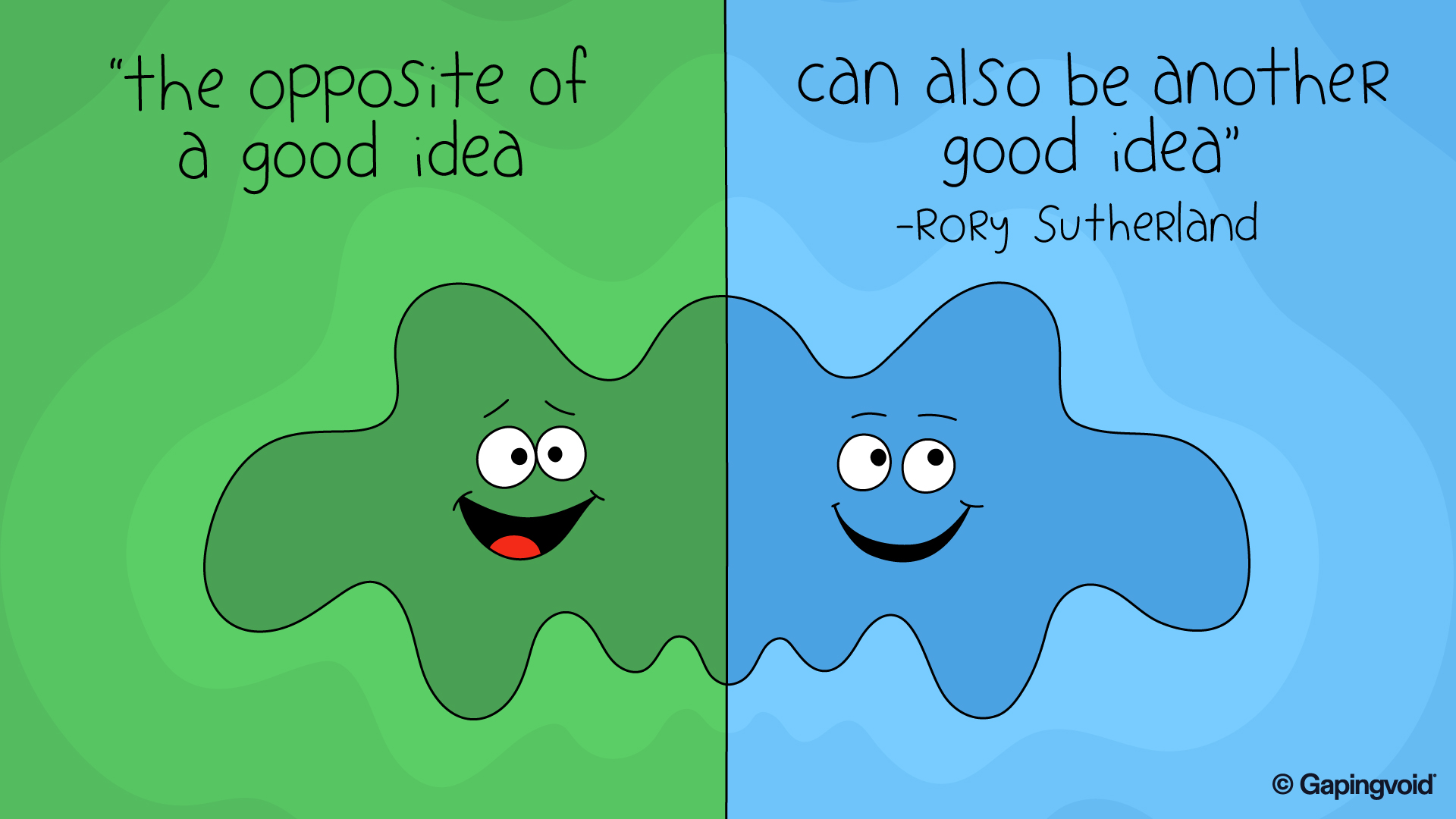
The opposite of a good idea can also be another good idea.
— Rory Sutherland
That line stops most leaders in their tracks.
Because we're trained to find the right answer. The best approach. The correct way to lead.
And yet anyone who has led a team for long enough knows that leadership doesn't work like that.
The same behaviour that builds trust in one moment can erode it in another.
The same approach that drives performance one week can undermine it the next.
The same decision that looks right from the top can look wrong from the ground.
This isn't a failure of leadership.
It's the nature of it.
Your culture is the compass
In a recent workshop, I asked a group of leaders to sort a set of behaviours.
Not to score them. Not to rank them against a competency framework.
Just to answer one question: what would allow this team to be its best — and what would hold it back?
What happened next was instructive.
Some cards were easy. A few stopped the room.
Not because the team couldn't agree — but because those behaviours had a genuine case on both sides.
Every behaviour has an effective side and a less effective one. Used well, it lifts the team — above the line. Overdone, or reached for in the wrong moment, it holds them back — below the line. The hard part isn't seeing that both exist. It's working out which one you're actually looking at, here, in this context.
"Being direct" — above the line when the team needs clarity. Below the line when it shuts down honest conversation.
"Stepping back" — above the line when people need ownership. Below the line when they need direction.
So the debate wasn't a problem to get past. It was the point.
Because deciding which side a behaviour belongs on — for this team, in this context, toward the culture you want — is the conversation that shapes how you actually work together.
It isn't the answer they land on that changes anything. It's how they get there — together.
That's the work Culture Science Cards was built for. Not to tell teams what good looks like. To help them decide for themselves.
Because here's what the research tells us — and Deci and Ryan spent decades on this — people commit to standards they helped define in a way they never commit to standards handed to them.
Agreed behaviour sticks. Assumed behaviour drifts.
Which brings us to the 11 Paradoxes of Leadership.
Each one is a genuine tension — two approaches, both of which can add real value, and both of which can constrain a team depending on the context.
We're not going to tell you which side to choose.
That's your call. It depends on your team, your context, and the culture you've decided you want to build.
What we will do is show you both sides of each tension — the value each brings, and the constraint each introduces — so you and your team can make that call with open eyes.
Because the goal isn't to find the right answer.
It's to make better decisions.
Good judgment is your candle in the dark. These 11 paradoxes are designed to help you find it.
Images in this post developed by © Gapingvoid Culture Design Group, and used with great thanks by Culture Science Cards.