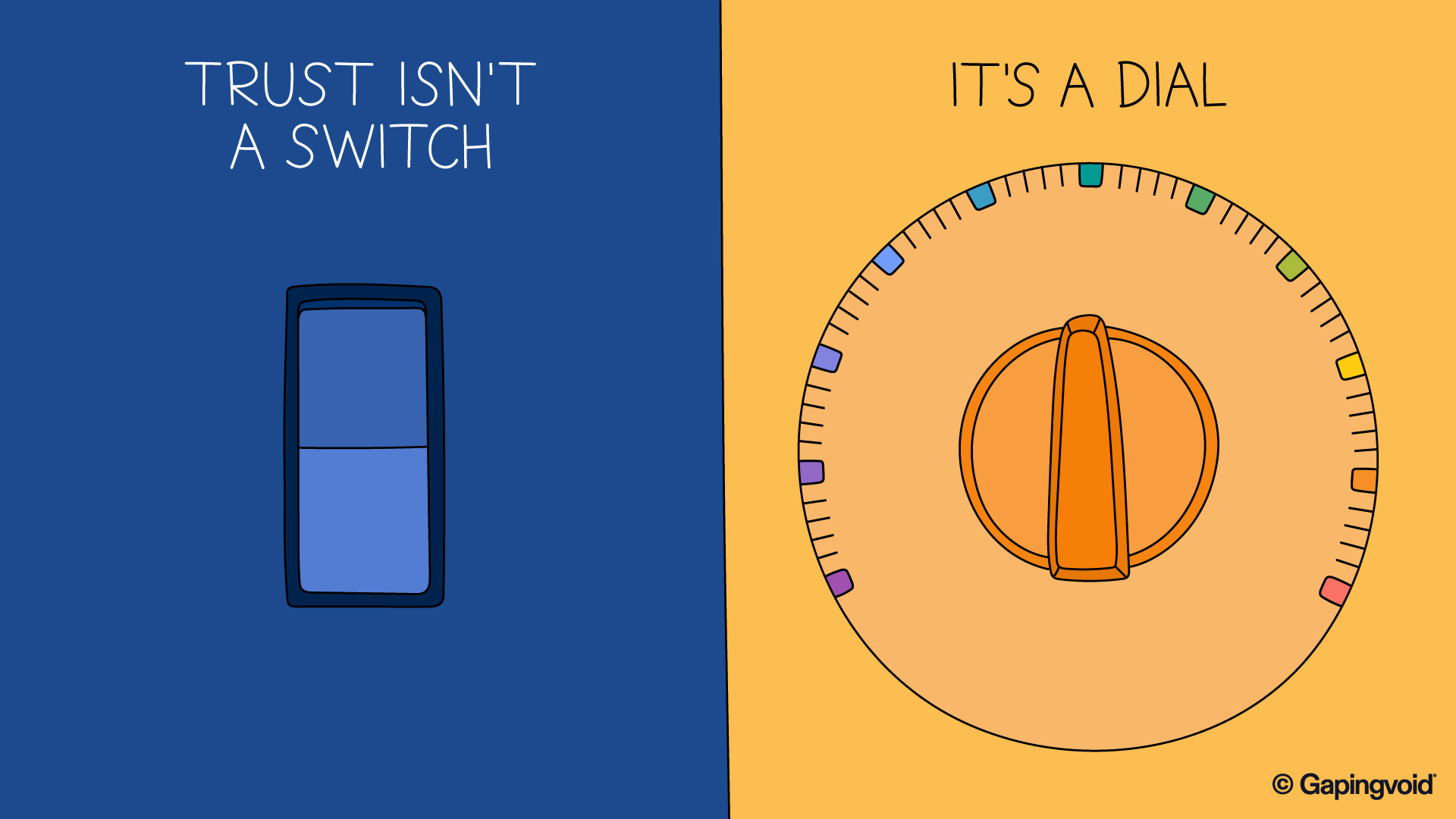
Trust isn't a switch.
It's a dial.
That distinction matters more than most leadership advice acknowledges.
A switch gives you two positions — on or off. Trust or don't trust. Delegate or control.
A dial gives you infinite gradations. How much visibility do you need right now? How much autonomy has this person earned? How much is at stake if this goes wrong?
The best leaders don't choose between trust and oversight.
They dial.
Know when to trust your peopleandKnow when to stay across what's going on
When trust serves your culture
Trust is the condition for ownership. When people feel genuinely trusted — not managed, not monitored, not second-guessed — they think and act like owners.
If your cultural aspiration includes initiative, accountability, or a team that doesn't need to be told what to do — trust is what creates the conditions for all of it.
Trust also signals something important: I believe you are capable. That belief, made visible, tends to become self-fulfilling.
A team that has agreed they back each other and give each other room to operate needs a leader who demonstrates that trust in how they show up every day.
When trust constrains your culture
Trust becomes a constraint when it tips into absence — when giving people space becomes not paying attention.
Issues surface too late. Standards drift. People who needed support didn't get it — not because the leader didn't care, but because they weren't close enough to see it.
If your cultural aspiration includes high standards, quality, or delivery — trust without visibility is a risk, not a virtue.
Blind trust isn't leadership. It's avoidance with good intentions.
When oversight serves your culture
Oversight isn't the opposite of trust. At its best, it's designed connection — a leader who stays close enough to see what's happening, offer support, and catch things early.
If your cultural aspiration includes quality, consistency, or delivery that can be relied upon — thoughtful oversight is often what makes those things possible.
Staying across the work isn't about control. It's about care. It says: this matters, and I'm close enough to help if you need it.
When oversight constrains your culture
Oversight becomes a constraint when it becomes control.
When everything is checked, nothing is truly delegated. When the leader's involvement signals distrust rather than support. When people stop bringing their thinking because they've learned the leader will override it anyway.
If your cultural aspiration includes ownership, creativity, or a team that grows — a leader who is always across everything is the biggest obstacle to all of it.
The question for your team
When you think about the culture you're trying to build —
Where does trust create the conditions your culture needs — and where does it leave gaps?
Where does oversight add value — and where does it get in the way of the very things you're trying to build?
Where is the dial currently set? And where should it be?
Culture Science Cards gives your team the language to have that conversation honestly — without it becoming personal.
Above the line. Below the line. In your context. For your culture.
Images in this post developed by © Gapingvoid Culture Design Group, and used with great thanks by Culture Science Cards.