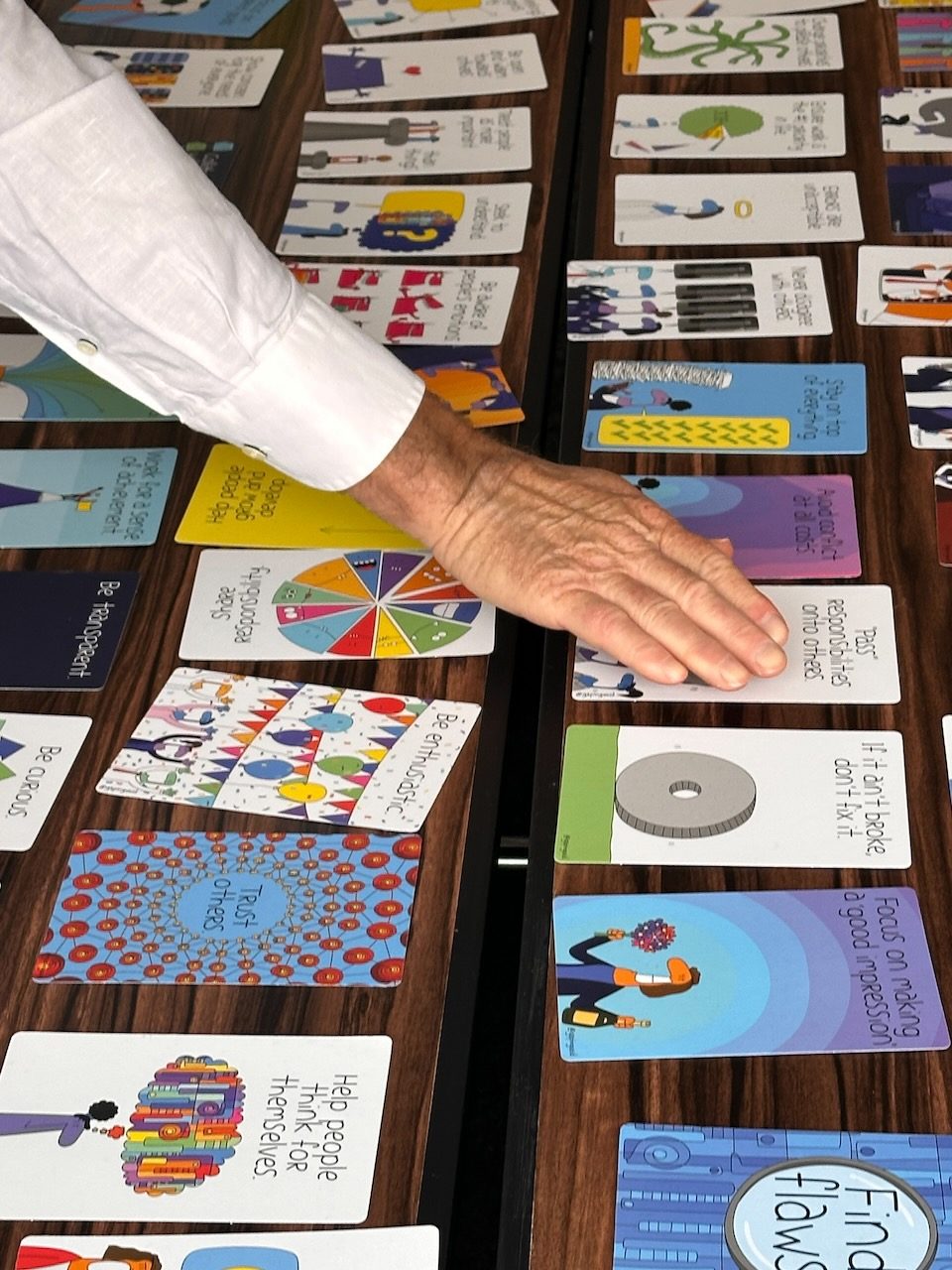
The front of a Culture Science Card has one job: name a specific, observable workplace behaviour and invite someone to sort it above or below the line.
The back of the card does something different. And the story of how the back became a facilitation resource is the best illustration of how this methodology developed — not through prior specification of how the tool should be used, but through observation of how it actually was.
The original design and its flaw
In the original version of the deck, cards were numbered randomly. The decision was deliberate. Random numbering prevented participants from treating the deck as a sequence — from preparing positions in advance, from working through cards in a predictable order, from thinking about what came next instead of engaging with what was in front of them. The randomness was a design feature, not an oversight.
What we noticed, across multiple sessions, was that participants were ignoring the backs of the cards entirely.
The random numbering was a reasonable design choice. The observation that participants were ignoring the card backs revealed that a resource was being left unused.
The front was doing its job. The back was carrying a random number and a theme category, and both were being overlooked. Participants engaged with the face of the card and flipped it over only when placing it — at which point the back provided no information that helped the conversation.
What sequential numbering unlocked
The response was a redesign. Cards were renumbered sequentially, one through eighty, corresponding to a consistent ordering. The backs were colour-coded by theme category. Two simple changes — and they activated the back of the card as a facilitation resource in ways the random numbering never had.
The first change was navigational. A facilitator attending to the cultural disclosures emerging in the conversation could now note card numbers rather than transcribing full text. "Cards 23, 47, and 61 all produced similar responses" is a reference that allows efficient return to specific moments without losing the group's thread.
The second change was cross-session. In the iterative model the methodology has evolved toward — where teams return to the cards across multiple sessions to track cultural movement over time — sequential numbering enables specific reference. "We placed card 34 above the line last time; I'm not sure we'd do that now." That sentence requires a numbering system. Without it, the conversation stops to locate the card before it can proceed.
The third change was visual. The colour coding of card backs by theme means that the physical layout of a sorted deck produces a visual culture map in which patterns are immediately apparent. A concentration of cards in the same colour below the line is visible at a glance, without reading. That visual pattern is itself a conversation prompt: "I notice a lot of the same colour below the line — what does that tell you?"
The principle it illustrates
Donald Schön described the reflective practitioner as someone who generates knowledge from practice — who uses each experience as data for the refinement of their tools and methods. The evolution of the card backs is a precise example of that process.
The principle extends beyond card design. Every facilitation session is a data source. Every moment a participant ignores a feature of your tool, or uses it in a way you didn't anticipate, or generates a conversation that goes somewhere unexpected, is information about how the tool is actually working versus how you assumed it would work.
The tools that get better are the ones built by people paying attention to the difference.