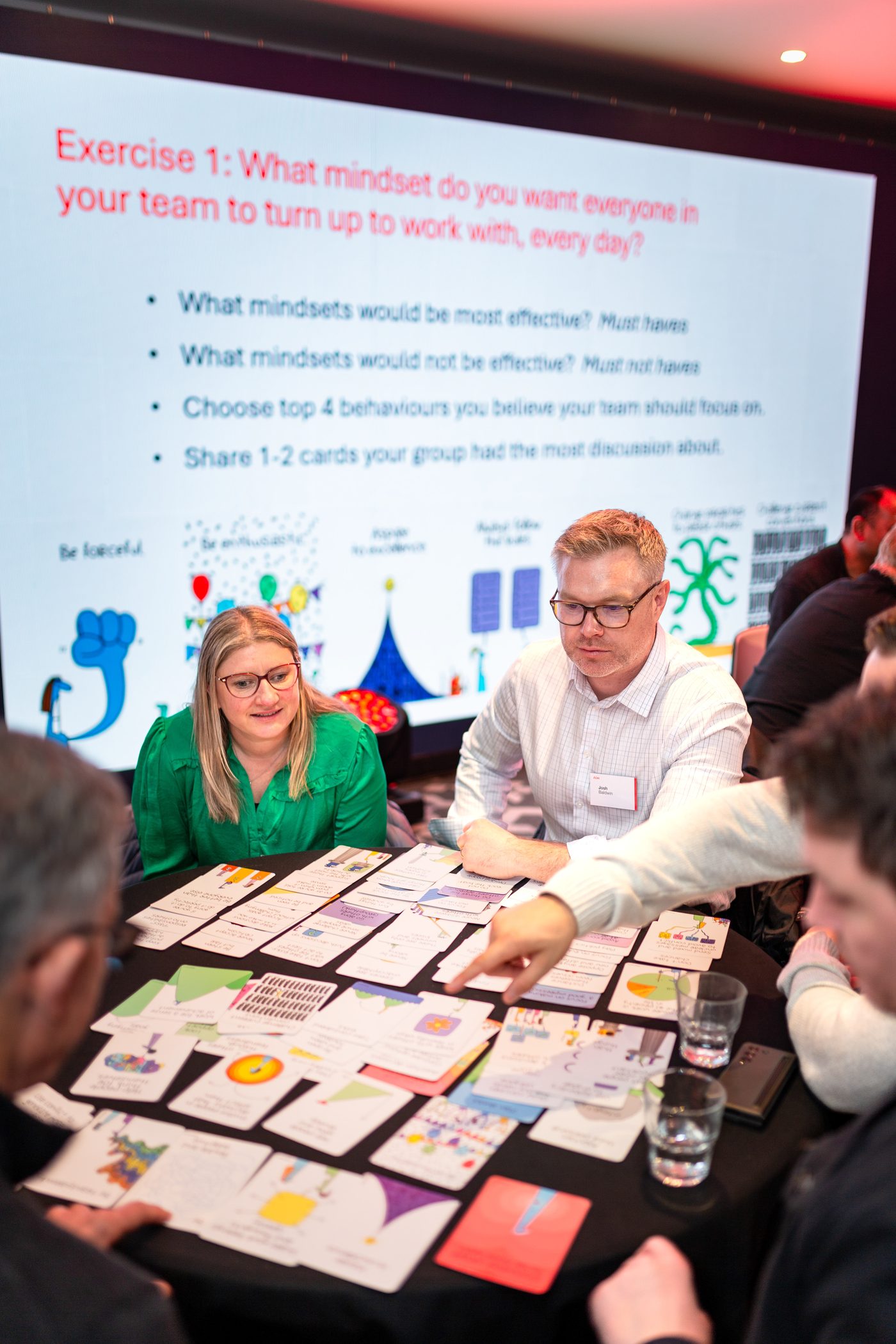
Culture Science Cards was not developed in a lab. It was developed in rooms.
Over five years, across more than fifty organisations and approximately two thousand participants, the methodology was tested, observed, and revised through a process that researchers might call iterative practitioner inquiry — and that practitioners might call learning from what actually happens when you put cards in front of real people doing real work.
Some of what the rooms taught is documented in the academic paper that underpins the cards. Some of it is harder to publish. Here is what I remember most.
The quality of a culture conversation is determined before anyone speaks.
The moment before the first card is placed is the most important moment in the session. The physical setup of the room, the question on the table, the presence or absence of hierarchy in the seating, the way the cards are distributed — all of it shapes what's possible before anyone says a word.
When I set up correctly — everyone on equal physical footing, cards distributed simultaneously so no one has a head start, a question framed around shared outcomes rather than individual assessment — the conversation that followed was reliably rich. When I got any of those elements wrong, I spent the rest of the session trying to recover ground I should never have conceded.
Silence is usually a sign the room is working.
Early on, I did what most facilitators do: I filled silence. If no one spoke for more than a few seconds, I would offer a prompt, ask a follow-up question, do something to keep the energy moving.
I was wrong to do this.
The most important things that happened in those rooms almost always happened slowly. The rush to fill silence was my anxiety, not theirs.
The silence in a good culture session is often the sound of people thinking carefully — of someone reaching for a word they haven't found yet, or deciding whether to say something true that feels risky, or reconsidering a position they'd previously defended. Learning to hold silence — to count to fifteen before intervening, to allow the room to stay uncomfortable until someone moved it — was one of the biggest improvements in my facilitation practice.
The moment a team surfaces its own gap is the most valuable moment in any session.
It happened in many forms. A card is placed above the line and someone says: "We say we do this. We don't." A card is placed below the line and someone says: "This is us under pressure — every single time." These moments are when the methodology is working at its most powerful. Not because I've created them — I haven't — but because the structure of the exercise has created the conditions for them to emerge.
The response is always to stay still. Not to summarise, not to reflect the insight back, not to move on. To let it land, and then to ask a single open question: "Can you say more about that?"
Items that produce easy consensus are almost always the wrong items.
The iterative refinement of the deck taught me to treat quick agreement as a warning sign rather than a success indicator. When a group sorts a card in three seconds with no discussion, one of three things has happened. The item is so obviously true as to require no conversation. The social dynamics of the room are suppressing genuine disagreement. Or the item itself isn't specific enough to produce a contested reading. All three are problems. All three have the same visible signature: fast, smooth, consensus.
The items I've replaced over the years have almost all been the ones that felt comfortable. The ones I've kept are the ones that produced friction.
The organisations where the methodology had the most impact were not the ones where the culture was worst.
They were the ones where someone was brave enough to let the conversation be real.
I've worked in rooms where the cultural problems were severe and the conversation was performative — where the presence of a senior leader meant everyone's cards went where they thought they should go rather than where the participant honestly believed they belonged.
I've worked in other rooms — sometimes with more challenging starting conditions — where something different was possible. Where the leader was genuinely curious rather than defensive. Those sessions produced conversations I still think about.
The cards create the conditions for an honest conversation. They don't mandate one. That still depends on something the cards can't supply: a leader who actually wants to know.