
There is a particular kind of silence in organisations that is not the absence of opinion. It is the presence of unanimous unexpressed opinion.
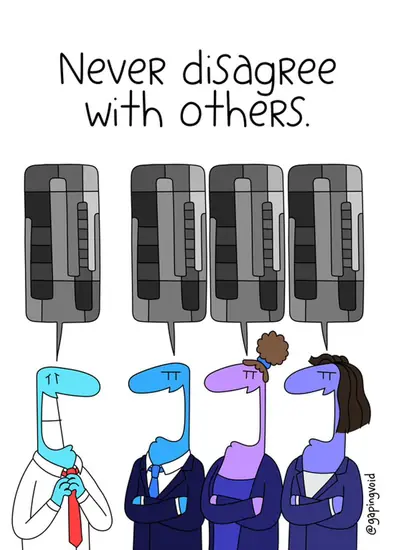
The psychologist Floyd Allport named it in 1924: pluralistic ignorance. Every member of a group privately holds a view that differs from what they believe the group norm to be. Everyone privately knows the culture is fear-driven, or that the leader's feedback style shuts people down, or that the performance review process rewards the wrong things. And everyone assumes that everyone else is fine with it. So no one says so. And the silence reads as agreement.
Pluralistic ignorance is one of the most persistent and least discussed forces in organisational life. It is the mechanism through which obviously dysfunctional cultural patterns are maintained across years and sometimes decades — not because anyone actively defends them, but because no one has created the conditions in which the privately-held dissent can become publicly expressed.
How it maintains itself
The conditions that maintain pluralistic ignorance are straightforward. In most organisations, honest expression of cultural critique carries social risk. You might be seen as a complainer, a poor team player, someone who doesn't understand the context. Senior people have reputational stakes. Junior people have more concrete ones. So everyone calibrates their public expression against what they assume the group norm to be — and the norm is maintained, even when no one actually holds it.
Survey instruments do not reliably disrupt this. Social desirability bias in self-report is well documented: people report the culture they believe they should have, or the culture they believe the organisation expects to see, rather than the culture they actually experience. The aggregate result smooths out the privately-held dissent into a profile that underestimates both the problem and the shared nature of the concern about it.
The most common response when pluralistic ignorance collapses in a card sort is some version of "I thought it was just me." It never is.
What happens when the cards arrive
The card sort disrupts pluralistic ignorance through its structural features. The dealing mechanism distributes cards without regard to seniority. The no-right-or-wrong architecture removes the evaluative risk of honest placement. The card as focus of discussion means a challenging view can be attached to an object rather than to a person. And the turn-based structure ensures that every participant engages before they can calibrate their response to others.
When participants begin expressing privately-held views that they had assumed were minority positions — and discover that those views are widely shared — the response is visible and often striking. Participant after participant places the same card in the same position, often with comments that reveal they were doing so hesitantly. The group watches its own consensus form, in real time, around a view that no one had previously said out loud.
Different tables in the same organisation, working simultaneously without knowledge of each other's placements, frequently converge on the same cards, the same patterns, the same below-the-line themes. This convergence is not coincidence. It is the evidence of a systemic cultural pattern that has existed for some time and has never had a structure through which it could become visible.
Why this matters for culture change
The collapse of pluralistic ignorance is not just psychologically satisfying. It is diagnostically significant in a specific way. When the dissent turns out to be universal rather than minority, the attribution of the problem shifts. It is no longer "some people feel this way." It is "we all know this is how it works." That shift — from individual concern to shared reality — is the precondition for the kind of collective redesign that culture change actually requires.
You cannot design your way toward a culture you cannot name. Pluralistic ignorance keeps the culture unnamed. The card sort names it — not because a consultant has told the group what they're seeing, but because the group has told themselves.
That is a qualitatively different starting point for everything that follows.