Amy Edmondson's research on psychological safety — the shared belief that the team is safe for interpersonal risk-taking — is now three decades old and remains the single strongest predictor of team learning behaviour ever identified. Google's Project Aristotle confirmed it as the most important factor in team effectiveness. Everyone working in culture, facilitation, or organisational development knows about it.
And most approaches to creating it remain fundamentally fragile.
The relational approach and its limits
The standard method for building psychological safety in facilitation contexts relies on relational skill — the facilitator's ability to create a warm, non-judgmental atmosphere through interpersonal warmth, active listening, careful pacing, and moment-to-moment management of group dynamics.
When the facilitator is skilled and consistent, this works. When they're not — when they're having an off day, when the group is particularly difficult, when hierarchy in the room is too strong, when the topic is too sensitive — the relational approach fails. Because it is dependent on a human performance that varies, it produces safety that varies.
There is a more reliable approach. It doesn't replace relational skill. It doesn't depend on it.
Psychological safety doesn't have to be a relational phenomenon. It can be designed into the structure of an intervention — so it works regardless of the facilitator's moment-to-moment performance.
Safety as architecture

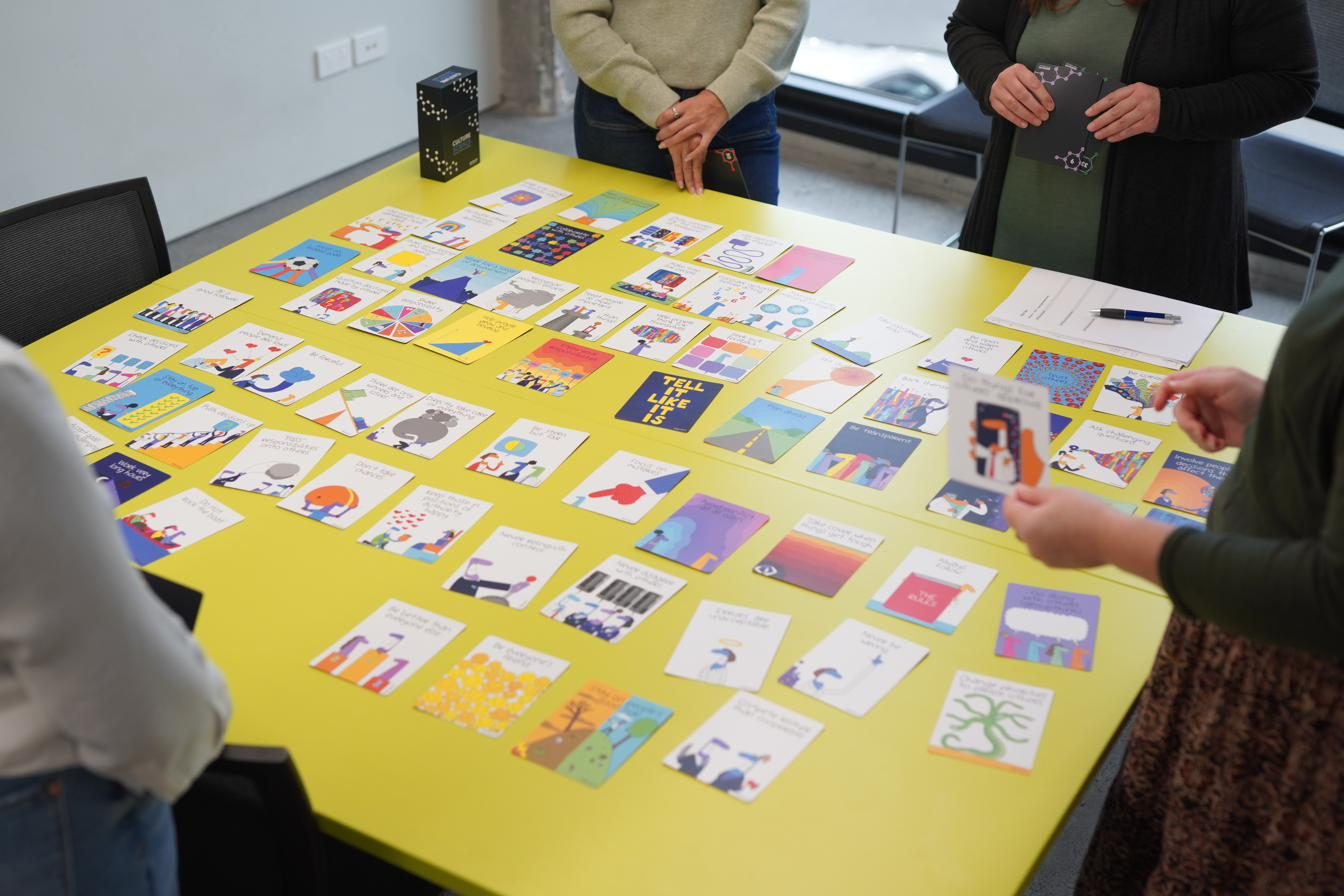
The Culture Science Cards methodology builds psychological safety into the structure of the intervention through several specific design choices, each of which addresses a different source of interpersonal risk in group settings.
The absence of correct answers removes the evaluative threat — the possibility of being wrong — that is the primary source of social risk in group conversation. It is not the facilitator's warmth that makes the space safe. It is the design of the space itself. When there is genuinely no wrong answer, the social calculus changes entirely. The cost of honest expression drops to near zero.
The dealing mechanism removes the social risk of speaking up by making participation structurally required rather than voluntarily offered. In most group settings, the decision to speak is a social calculation — am I senior enough, confident enough, informed enough? The deal removes that calculation. You received a card. You engage with it. The structure has decided, not you.
The card as focus of discussion means that challenging views can be attached to an object rather than to a person. "This card suggests we do too much of this" is a different social act from "I think we do too much of this." The former invites examination of an idea. The latter invites examination of a person. The physical mediation changes what honest expression costs.
The no-seniority dealing sequence temporarily suspends the organisational hierarchy that normally governs who speaks first, for how long, and about what. The CEO receives a card at the same moment and in the same way as the graduate. That structural equality, even if temporary, changes what is sayable in the room.
What this means for facilitation
If psychological safety can be designed architecturally rather than created interpersonally, then the skill most worth developing in facilitators is not interpersonal warmth but intervention design — the ability to construct conversation structures that produce the conditions they seek, consistently, regardless of the room.
Relational skill still matters. A skilled facilitator working with a well-designed structure will produce better outcomes than an unskilled one. But the floor — the minimum quality of psychological safety produced — is set by the design, not the person. That minimum is what makes the methodology transferable, scalable, and certifiable.
The goal is a structure in which people tell themselves the truth about their culture regardless of who is holding the pen. When you've designed that, you've built something genuinely useful.