Ask most people to assess a behaviour and they'll reach immediately for a verdict. Good or bad. Constructive or destructive. Above the line or below it.
That instinct is understandable. It's also, in the context of organisational culture, almost always the wrong question.
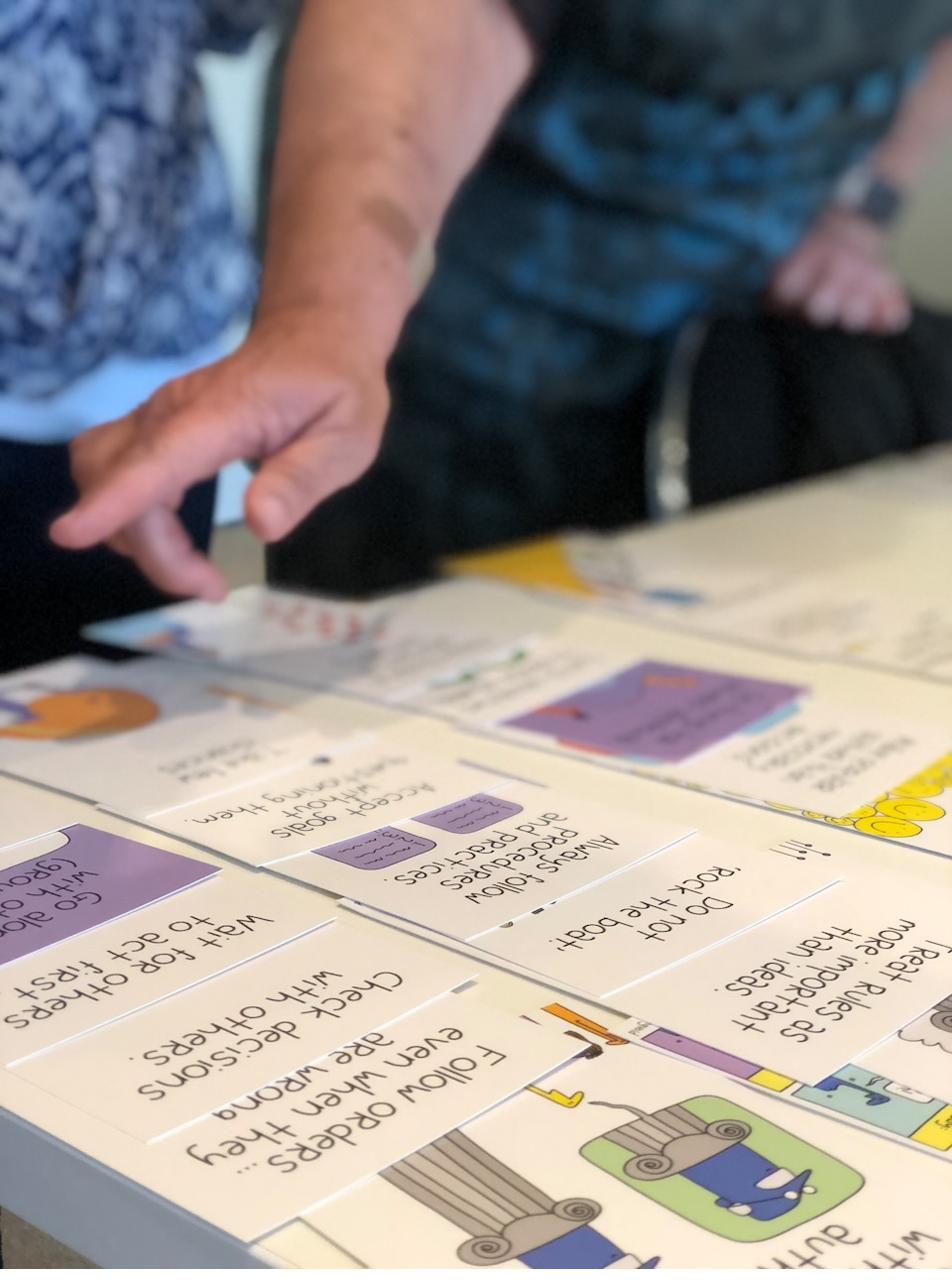
Consider a few behaviours that appear in the Culture Science Cards deck.
Follow the rules. Is that good or bad? It depends entirely on which rules, in which organisation, at which moment. Rules designed for a previous era, followed mindlessly, can throttle an organisation's capacity to adapt. Rules that protect people from genuine harm, routinely ignored, can be catastrophic.
Check decisions with others. Good or bad? In a junior employee early in a complex role, checking decisions reflects appropriate humility. In a senior leader who defers every judgment upward despite having the authority and experience to decide, it becomes something else — a pattern of learned helplessness that stalls progress and signals a lack of confidence the organisation can't afford.

Be critical. The capacity to find what's wrong, to identify risk before it materialises, to ask the uncomfortable question — these are genuine organisational assets. A team with nobody willing to be critical will sail cheerfully toward preventable disasters. A team where criticism is the dominant register, where every idea is met with interrogation, where the first question is always what could go wrong rather than what could go right — that team loses its ability to innovate, to experiment, and eventually to attract the kind of people who aren't interested in spending their working lives being systematically disheartened.
The most useful question to ask about any behaviour is not whether it is good or bad in the abstract — but what happens when it becomes the habitual pattern.
This is the frequency insight. And it's the central theoretical idea behind Culture Science Cards.
Behaviours aren't good or bad in isolation. They're good or bad in pattern. More precisely: there are behaviours that can be practised regularly, even habitually, and still build the conditions for high performance — trust, openness, ownership, learning. And there are behaviours that may have a legitimate occasional role but consistently weaken those conditions when they become normal, expected, taken for granted.
The above and below line architecture of the cards encodes this distinction. It's not a moral classification. It's a performance classification — a sorting of behaviours by what they produce when they repeat.
Above the line: behaviours whose repetition compounds. The more consistently they're practised, the stronger the culture becomes. Authenticity builds trust. Empowerment builds capability. Collaboration builds collective intelligence. These behaviours are self-reinforcing; the culture they create makes them easier to sustain.
Below the line: behaviours that may serve a legitimate purpose in context but create compounding damage as they normalise. Approval-seeking, used occasionally, reflects social sensitivity. Habitual approval-seeking produces a culture where honest feedback is impossible, because telling someone what they don't want to hear has become socially costly. Control, exercised occasionally, reflects appropriate accountability. Habitual control produces a culture where initiative atrophies, because initiative requires the freedom to fail that habitual control systematically removes.
The philosopher Aristotle had a version of this insight. Virtue, he argued, is not a single act but a habitual practice — not that you were courageous once, but that you're the kind of person who acts courageously because you've built that pattern into who you are. The same logic applies, in reverse, to the behaviours that erode culture. It's not that someone was critical once, or avoided conflict once, or deferred a decision once. It's that those behaviours have become the pattern.
This reframe matters practically for anyone doing culture work. It shifts the conversation from judgement to observation. Instead of "that's a bad behaviour," the question becomes "how often is this happening, and what does that frequency produce?" The former triggers defensiveness. The latter opens inquiry.
It shifts the focus from individual character to collective pattern. Culture isn't made of good or bad people. It's made of repeated behaviours — many of which made perfect sense given the pressures that produced them — that have accumulated into something that now either helps or limits the organisation's ability to perform.
Not good or bad. How often.
It's a small reframe. The conversations it unlocks are anything but small.