Most organisations manage their intentions while their patterns do something else entirely.
They articulate values. They design programmes. They communicate from the top. They measure engagement. And then they watch, with genuine puzzlement, as the culture they intended to build fails to materialise — while the culture they've actually built, the one encoded in the repeated daily behaviours of the people who work there, continues on undisturbed.
The gap between intended culture and lived culture is not a communication problem. It's a definitional problem.
What culture actually is
Culture is not an attitude, a value, or a belief. Culture is what people repeatedly do, tolerate, reward, and avoid.
This definition has a long theoretical lineage. The sociologist Edgar Schein described culture as enacted assumption: the things an organisation actually believes show up not in what it says but in what it does, consistently and without explicit decision, because the assumptions are so embedded they've become invisible. Pierre Bourdieu used the concept of habitus to describe the same phenomenon — the set of dispositions, habits, and taken-for-granted practices through which social groups reproduce themselves across time.
Both are making the same point: culture is made of behaviour, not of belief. And behaviour, unlike belief, is observable, discussable, and designable.
The habit loop at organisational scale
Charles Duhigg's research on the habit loop provides a mechanism for understanding how this works at the organisational level. Individual behaviours become habitual through a cue-routine-reward cycle: a trigger prompts a behaviour, the behaviour produces a reward (social rewards like belonging and approval are often more powerful than formal ones), and the reward reinforces the behaviour until it becomes automatic. When enough people are running the same loops — when the same cues produce the same routines across a significant portion of the organisation — the result is a cultural pattern.
This is why culture initiatives that focus on values and beliefs so often fail to produce change. They're targeting the wrong variable. You can change what people say they believe relatively easily. Changing what they do, repeatedly, in the situations that actually matter — that requires something different.
Making the pattern visible
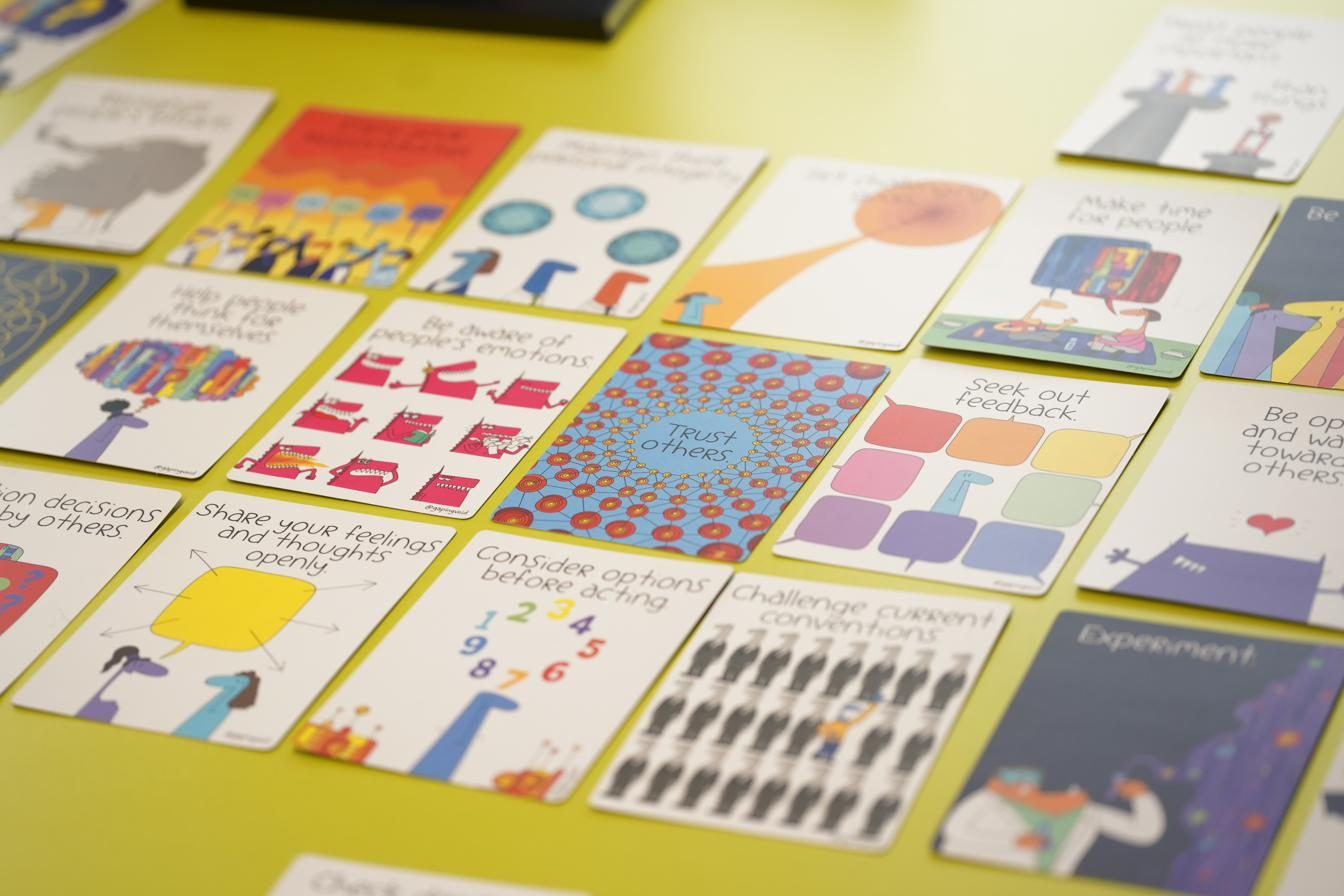
It requires making the existing patterns visible. This is what Culture Science Cards is designed to do. Not to measure culture, not to prescribe it, but to make it visible in a room full of the people who are enacting it — in their own words, through their own sorting, against their own experience — and to create the conditions for a genuine conversation about what patterns are serving them and which ones aren't.
The exercise isn't primarily about the cards. It's about the conversation the cards make possible: the first time many teams have ever sat together and asked, specifically, what repeated behaviours characterise how we actually work — not how we say we work, not how we intend to work, but what the pattern actually is.
That conversation changes things. Not because awareness is sufficient — it isn't — but because you cannot design your way toward a culture you cannot see.
The values statement is aspirational. The behavioural pattern is real. You can work with what's real.