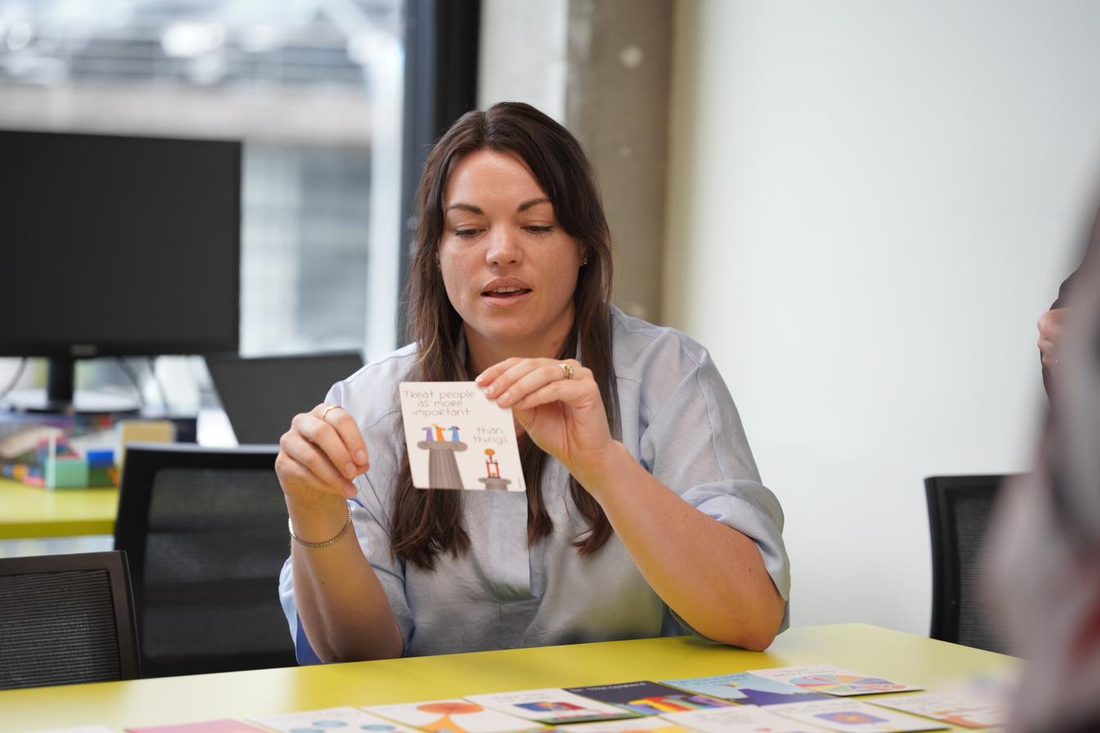
In the early version of the Culture Science Cards deck, one of the cards read: cooperate with others.
On the surface, a straightforward item. Cooperation is generally considered a positive organisational behaviour. The card sat comfortably in the Collaborative theme. In theory, it was doing its job.
In practice, something kept going wrong.
What the room was hearing
Across facilitation sessions, we noticed a pattern. When groups encountered this card, a subset of participants — particularly those in junior or subordinate roles, or those with experience in highly hierarchical organisations — were interpreting it in ways we hadn't intended.
In many workplace contexts, cooperation carries a power asymmetry that's invisible until you're on the wrong side of it. The junior person cooperates with the senior person's wishes. The compliant person cooperates with the dominant person's preferences. Cooperation, in this reading, is compliance with a collegial face.
Words mean what they do in the room — not what the dictionary says. In many rooms, "cooperate" means "do what you're told, pleasantly."
The card wasn't generating a conversation about joint working. It was generating a conversation about subservience — about what it means to "cooperate" when you don't actually have an equal voice. That's a valuable conversation. But it's not the one the card was designed to start.
One word
The solution was a single word change. Cooperate with others became collaborate with others.
Collaboration implies mutual contribution. Two or more parties bringing something to a shared endeavour, neither subsuming their perspective into the other's. The word carries an assumption of relative equality that cooperation does not.
The replacement card restored the intended meaning — joint working, shared effort, collective contribution — while redirecting the productive ambiguity toward a more generative conversation. Now the contestable question wasn't about power dynamics in cooperation; it was about what genuine collaboration looked like in this organisation, when it was happening, and what got in the way of it happening more.
Same theme. One word different. Completely different conversation.
The principle it revealed
This example illustrates what we came to think of as the observed meaning-in-use principle of instrument development. Words don't mean what dictionaries say they mean. They mean what they do in the contexts in which they're used — what associations they trigger, what experiences they activate, what frames they impose on the conversation that follows.
The philosopher Wittgenstein put it plainly: meaning is use. When designing items for a facilitation instrument, the relevant question isn't "what does this word mean?" but "what does this word do in the room?"
The only reliable way to find those gaps is observation. Not piloting with experts who share your vocabulary, but testing with the actual populations — the junior employees, the people from hierarchical organisations, the participants whose experience of workplace language is different from the designer's — and watching what the words actually do.
Every item in the Culture Science Cards deck has been through this process. Some of the most important changes came from watching a single card consistently produce the wrong conversation — and asking not "what did we mean?" but "what did they hear?"
One word changed everything. In this case, the word was collaborate.